by The Associated Press, on Jan 20, 2010 7:00 am ET
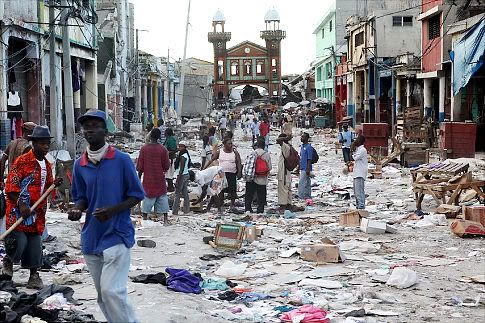
PORT-AU-PRINCE, Haiti (AP) -- A strong earthquake struck Haiti on Wednesday morning, shaking buildings and sending screaming people running into the streets only eight days after the country's capital was devastated by a previous quake.
The U.S. Geological Survey said the 6.1 magnitude quake hit at 6:03 a.m. (1103 GMT) about 35 miles (56 kilometers) northwest of the capital of Port-au-Prince. It struck at a depth of 13.7 miles (22 kilometers) but was located too far inland to generate any tidal waves in the Caribbean.
Wails of terror rose Wednesday from frightened survivors of the apocalyptic quake that struck eight days ago as people as people poured out of unstable buildings. It was not immediately possible to ascertain what additional damage the new quake may have caused.
Last week's magnitude-7 quake killed an estimated 200,000 people in Haiti, left 250,000 injured and made 1.5 million homeless. A massive international aid effort has been launched, but is struggling with overwhelming logistical problems.
Still, search-and-rescue teams have emerged from the ruins with some improbable success stories -- including the rescue of 69-year-old ardent Roman Catholic who said she prayed constantly during her week under the rubble.
Ena Zizi had been at a church meeting at the residence of Haiti's Roman Catholic archbishop when the Jan. 12 quake struck, trapping her in debris. On Tuesday, she was rescued by a Mexican disaster team that was created in the wake of Mexico City's 1985 earthquake.
Zizi said that after the quake, she spoke back and forth with a vicar who also was trapped. But after a few days, he fell silent, and she spent the rest of the time praying and waiting.
"I talked only to my boss, God," she said. "And I didn't need any more humans."
Doctors who examined Zizi on Tuesday said she was dehydrated and had a dislocated hip and a broken leg.
Elsewhere in the capital, two women were pulled from a destroyed university building. And near midnight Tuesday, a smiling and singing 26-year-old Lozama Hotteline was carried to safety from a collapsed store in the Petionville neighborhood by the French aid group Rescuers Without Borders.
Crews at the cathedral compound site Tuesday managed to recover the body of the archbishop, Monsignor Joseph Serge Miot, who was killed in the Jan. 12 quake.
Authorities said close to 100 people had been pulled from wrecked buildings by international search-and-rescue teams. Efforts continued, with dozens of teams sifting through Port-au-Prince's crumbled homes and buildings for signs of life. But the good news was overshadowed by the frustrating fact that the world still can't get enough food and water to the hungry and thirsty.
"We need so much. Food, clothes, we need everything. I don't know whose responsibility it is, but they need to give us something soon," said Sophia Eltime, a 29-year-old mother of two who has been living under a bedsheet with seven members of her extended family.
The World Food Program said more than 250,000 ready-to-eat food rations had been distributed in Haiti by Tuesday, reaching only a fraction of the 3 million people thought to be in desperate need. The WFP said it needs to deliver 100 million ready-to-eat rations in the next 30 days. Based on pledges from the United States, Italy and Denmark, it has 16 million in the pipeline.
Even as U.S. troops landed in Seahawk helicopters Tuesday on the manicured lawn of the ruined National Palace, the colossal efforts to help Haiti were proving inadequate because of the scale of the disaster and the limitations of the world's governments. Expectations exceeded what money, will and military might have been able to achieve. So far, international relief efforts have been unorganized, disjointed and insufficient to satisfy the great need. Doctors Without Borders says a plane carrying urgently needed surgical equipment and drugs has been turned away five times, even though the agency received advance authorization to land.
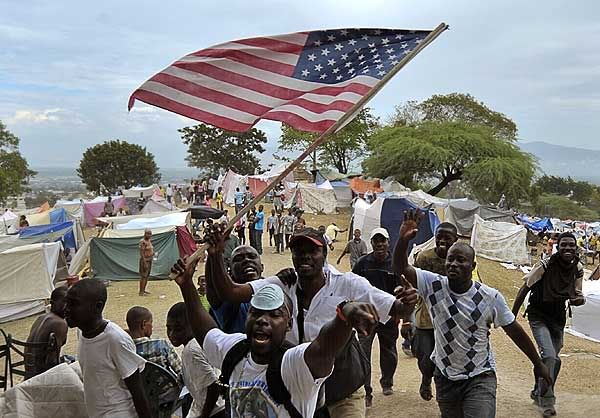
A Haitian man waves the American flag during distribtion of relief goods at a refugee camp in Port-au-Prince on 19 January, 20010. The Haitian government said that 75,000 people had been killed, 250,000 were injured and a million left homeless in the quake seven days ago.
Wednesday, January 20, 2010
New 6.1 Quake Hits Haiti, People Flee Into Streets

Tuesday, January 19, 2010
Haiti Relief Operation: Who Should Be In Charge?
by Tom Bowman
January 19, 2010
The Pentagon is moving troops, planes and ships to take part in the Haitian relief effort. That effort is slower than expected. One reason: the military is coping with the same challenges as civilian aid groups — a small airport and a demolished port. But one U.S. general says the White House made a mistake by putting the State Department's Agency for International Development in charge of the effort instead of the U.S. military.
Now the U.S. military is moving in troops, planes and ships to Haiti, but faces the same challenges as civilian aid groups - a small airport and a demolished port.
They are called the Ready Brigade of the 82nd Airborne Division -able to deploy within 18 hours, anywhere in the world for combat or humanitarian missions. On Friday, the nation's top military officer, Admiral Mike Mullen, said 100 of those paratroopers were already in Haiti. And the rest of the brigade will be on the ground by the end of the weekend.
That didn't happen. Less than one-third of the 3,500 troops were on the ground as of last night to help in the relief effort. The rest are expected to arrive some time this week. Why? Major Christian Sorenson, a spokesman for the 82nd, blamed a clogged Port-au-Prince airport.
"The main reason, of course, is that the airfield at Haiti itself. There's a bottleneck there. You know, we're limited to the accessible runways there and we are not the only aircraft that are trying to land at this time. In addition it wouldn't make sense for the 82nd to parachute into Haiti before the military is able to support them on the ground. When you have that many troops on the ground, those are, again, 3,000 additional mouths to feed." says Sorenson.
That's not good enough for retired Lieutenant General Russel Honore, who led relief efforts for Hurricane Katrina. On CNN yesterday he said:
"We need to drop the rest of that second brigade of the 82nd Airborne in there in daylight tomorrow morning and get this problem taken care of. The Obama administration made a mistake in putting the Agency for International Development in charge of the American effort rather than the U.S. military. They just don't have the operational experience. It requires a lot of logistics on the ground, quickly. It requires a lot of capability to evacuate people. And when you put USAID in the lead of this, I - and again, it's nothing personal against them - the military's waiting for USAID to tell them what to do."
At this point to change it Honore says:
"I'd put General Keen in charge of the entire operation, working in support of the president and our ambassador on the ground, senior U.S. representative."
That's Lieutenant General Ken Keen, the senior American officer in Haiti. He told reporters yesterday in Port-au-Prince, the U.S. is working with the Haitian government and the United Nations. The Americans are not in the lead.
Says Keen: "No. We are in support of the government of Haiti and the United Nations as it relates to humanitarian assistance. What we want to do is use our resources as best we can to enable the humanitarian assistance supplies to get out to the points indicated."
What Keen just mapped out is part of the problem, says retired Lieutenant General Gus Pagonis - too many people. Clearly, there has to be one agency, one single point of contact, otherwise logistics just don't work. You've got too many people stirring the pot. Pagonis should know - he was in charge of moving all troops and supplies during the 1991 Persian Gulf War.
Says Pagonis: "In all normal disasters, that's what happens. The government thinks they're in charge; the military thinks they're in charge; the police think they're in charge. With our own disaster in New Orleans we had that huge problem. The Pentagon can take steps on its own to make things better - starting with that airport. I suggest carving out a second runway to land military C-130 aircraft, carrying water, food or paratroopers from the 82nd Airborne. The C-130s, you could set up an unimproved runway pretty rapidly if you have the bulldozers or the expertise to be able to clear the land. That's what they need to do."
But as of last night, no one in the military was talking about a second runway.
Tom Bowman, NPR News, Washington.
U.S. Troops Land At Haiti's Presidential Palace
by Scott Neuman
January 19, 2010
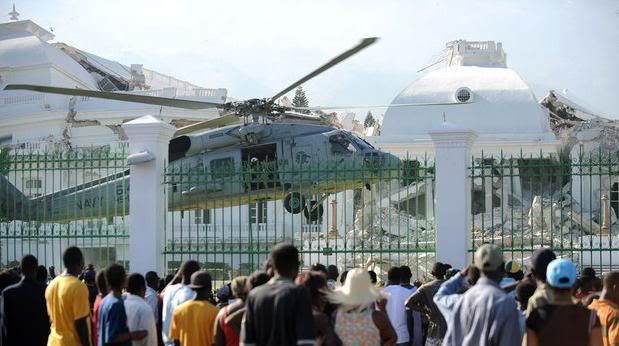
Haitians watch as a U.S. Navy helicopter lands Tuesday in front of the heavily damaged presidential palace in Port-au-Prince.
Dozens of U.S. troops landed by helicopter at Haiti's ruined presidential palace Tuesday to help with security and expand the flow of aid in the Caribbean nation. Their arrival, part of an influx of thousands of U.S. military personnel expected this week, comes as desperate earthquake survivors increasingly turn to looting amid the devastation and as officials say the death toll could reach 200,000.
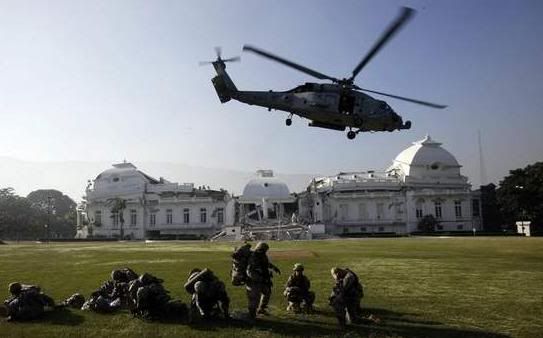
A U.S. Navy helicopter takes off in front of the National Palace after members of the U.S. Army 82nd Airborne, front, landed in Port-au-Prince, Tuesday, Jan. 19, 2010. U.S. Navy helicopters touched down on the grounds of Haiti's damaged presidential palace bringing reinforcements in the struggle for security and earthquake disaster relief.
Hundreds of Haitians gathered outside the wrought-iron gates at the palace in the capital, Port-au-Prince — some to cheer, others simply to gawk — while the U.S. Navy copters landed and soldiers from the Army's 82nd Airborne Division took control of the palace. U.S. Marines landed in helicopters west of the city, the first of about 800 expected to go ashore.
One week after the tragedy, authorities say 1.5 million residents of Port-au-Prince are displaced, and aid deliveries are only reaching a small portion of the population. Meanwhile on Tuesday, the U.N. Security Council unanimously approved 3,500 additional troops and police officers to help bolster the 9,000-strong international force.
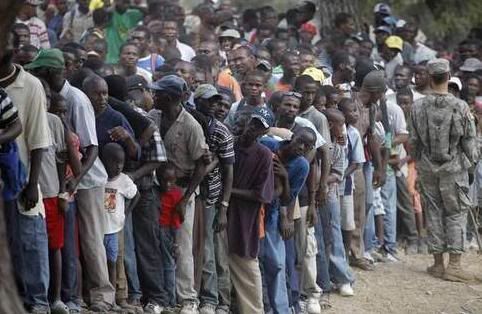
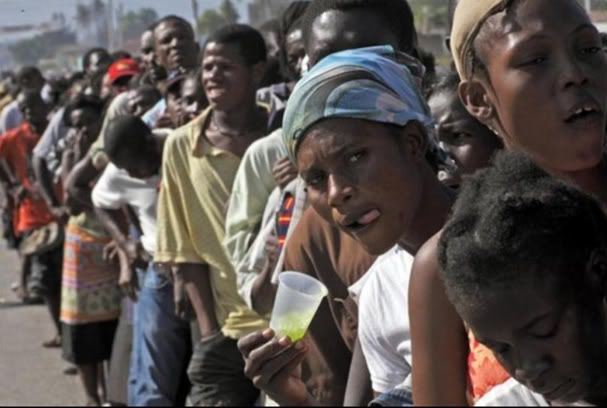
A woman gestures as she waits in line for food from the United Nations in the Cite Solell neighborhood in Port-au-Prince, Tuesday, Jan. 19, 2010. The food ran out before most of the line could pass. The U.N. Security Council has unanimously approved 3,500 extra troops and police officers to beef up security in Haiti and ensure that desparately needed aid gets to earthquake victims.
Friday, January 15, 2010
Haiti Earthquake: The Aftermath
Earthquake in Haiti: Marines head to Haiti to control angry looters on disaster-ravaged island
BY BRIAN KATES AND CORKY SIEMASZKO
DAILY NEWS STAFF WRITERS
Originally Published:Friday, January 15th 2010, 10:48 AM
Updated: Friday, January 15th 2010, 1:03 PM
As aid begins to pour in to Haiti, experts are stressing the importance of coordination between a weak central government, a constellation of non-governmental groups and international governments.
Send in the Marines! Six years after the U.S. dispatched the fighting force to Haiti to prevent a civil war, the Leathernecks are heading back Monday to keep anarchy from breaking out in the earthquake-ravaged country. And not a moment too soon. The United Nations reported that its warehouses in the Haitian capital of Port-au-Prince had been looted and it didn't know how much of its pre-quake stockpile of 15,000 tons of food aid remained. Haitian police "are not visible at all," because many fled their posts after the quake hit Tuesday, UN officials said.
"We are worried about security," Brazilian Defense Minister Nelson Jobim warned Friday after visiting the shattered capital.
"As long as the people are hungry and thirsty, as long as we haven't fixed the problem of shelter, we run the risk of riots."
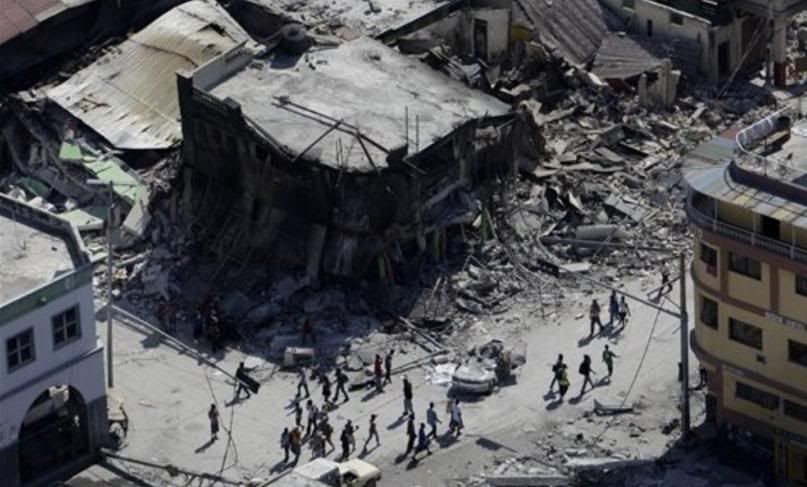
People walking among damaged buildings in Port-au-Prince, Friday, Jan. 15, 2010.
The Marines will be reinforcing 300 troops from the U.S. 82nd Airborne Division already on the ground and other soldiers aboard the aircraft carrier USS Carl Vinson, Lt. Gen. Ken Keen told ABC's "Good Morning America."
"We have much more support on the way," he said. "Our priority is getting relief out to the needy people."
By Monday, there should be 5,500 U.S. soldiers and Marines in Haiti providing security, White House spokesman Robert Gibbs said. The Marines were last sent to Haiti in 2004 to restore order after the government of Jean-Bertrand Aristide was toppled. Before that, the Marines were dispatched several times to protect American interests in the turbulent country. Their 19-year occupation of the country, which ended in 1934, was deeply resented by many Haitians.
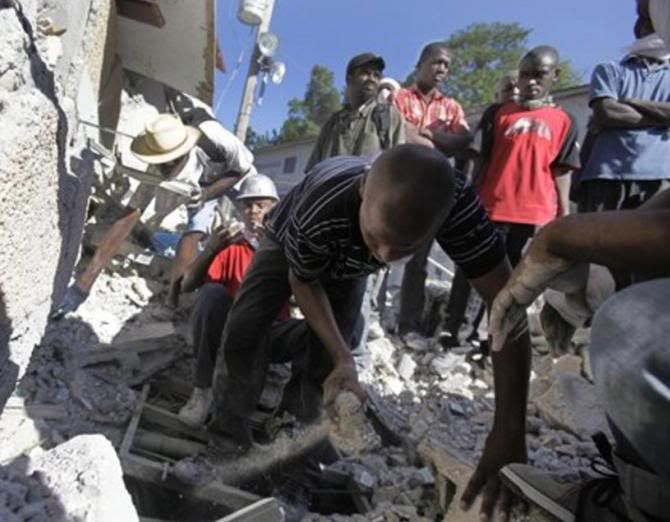
Men dig by hand trying to reach people they believe are still alive trapped in the rubble of a collapsed building in Port-au-Prince, Friday, Jan. 15, 2010.
Cuba gave the U.S. government permission to fly desperately-needed aid through their air space. That deal, which pushes aside decades of Cold War animosity between Washington and Havana, will cut a precious 90 minutes off the one-way flight from Guantanamo to Haiti. It is also expected to help open the logistical bottlenecks at the damaged Port-au-Prince airport which has caused Haitians to receive just a trickle of aid four days after the quake. "I don't think that a word has been invented for what is happening in Haiti," said Liony Batista, the Food For the Poor project manager in Port-au-Prince. "It is total disaster."
The UN reported that an estimated 300,000 people have been left homeless and one in 10 homes in the capital were destroyed. Getting around Haiti (a desperately poor country with shoddy roads) has always been hard, and the damage done by the quake has made getting aid to the survivors (many living in the streets) even harder.
"The physical destruction is so great that physically getting from point A to B with the supplies is not an easy task," World Food Program spokeswoman Emelia Casella said. The WFP, which began organizing distribution centers for food and water on Thursday, was preparing shipments of enough ready-to-eat meals to feed 2 million Haitians for a month.
Also en route (from more than 20 countries around the world) were planeloads of high-energy biscuits and other food, tons of water, tents, blankets, water-purification gear, heavy equipment for removing debris, helicopters and other transport. More than $400 million in aid has been pledged to Haiti, a fourth of that from the U.S. The Red Cross estimates 45,000 to 50,000 people were killed. The toll could go much higher as the spectre of infectious disease spreads. Hundreds of bodies remained stacked outside the overflowing Port-au-Prince morgue. Limbs of the dead protruded from the rubble of crushed schools and homes. There were still reports of rescuers freeing people who had been trapped under the rubble for days. But a more common sight was of bulldozers carrying corpses to a mass grave.
Haitian President Rene Preval told The Miami Herald that over a 20-hour period government crews had removed 7,000 corpses from the streets. But countless bodies remain unburied - and unclaimed. Outside a pharmacy, a dead woman lay covered by a sheet, her tiny foot poking out from under the covering.
Read more:
http://www.nydailynews.com/news/world/2010/01/15/2010-01-15_earthquake_in_haiti_as_desperate_victims.html#ixzz0chvGqvp5
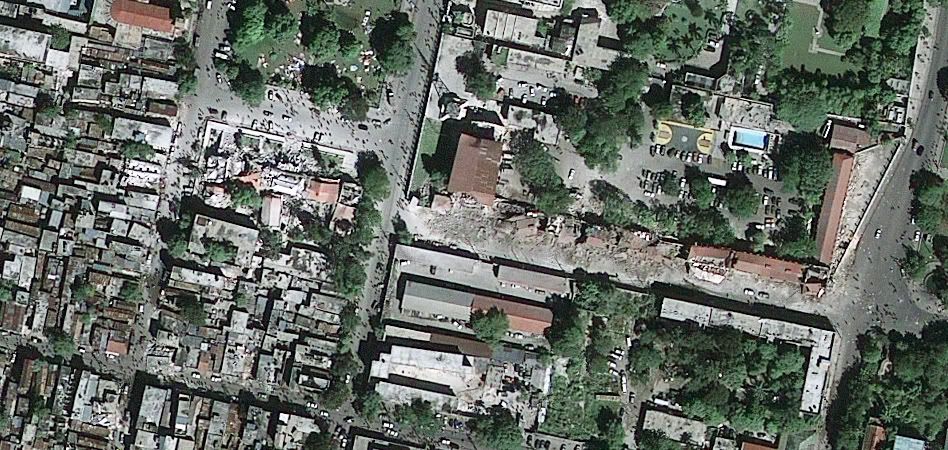
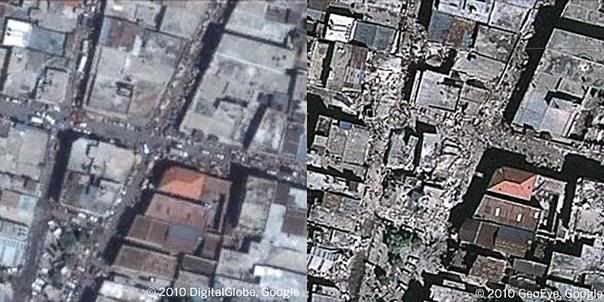
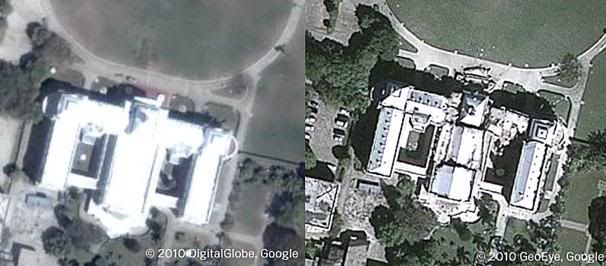
This half-meter resolution satellite image shows Port-au-Prince, Haiti after a 7.0-magnitude earthquake struck the area on Jan. 12, 2010. The image clearly shows extensive damage, roads covered with debris from collapsed structures, and people crowded in the streets and public places such as sports fields and stadiums. The white-colored National Palace shows damage along the roof line. The image was taken by the GeoEye-1 satellite from 423 miles in space at 10:27 a.m. EST on Jan. 13, 2010 as it moved from north to south over the Caribbean at a speed of four miles per second.
The Red Cross has stated that as many as 3 million Haitians have been affected by the earthquake, with as many as 100,000 deaths likely, according to Haiti's prime minister. Since the quake's epicenter was right off the capital city, Port-au-Prince, most of the official buildings, from government officials' residences to jails and hospitals, have been significantly damaged or completely leveled.